Kyiv National University of Technologies and Design Launches the European Virtual Hub for Education and Adaptation in Emergencies
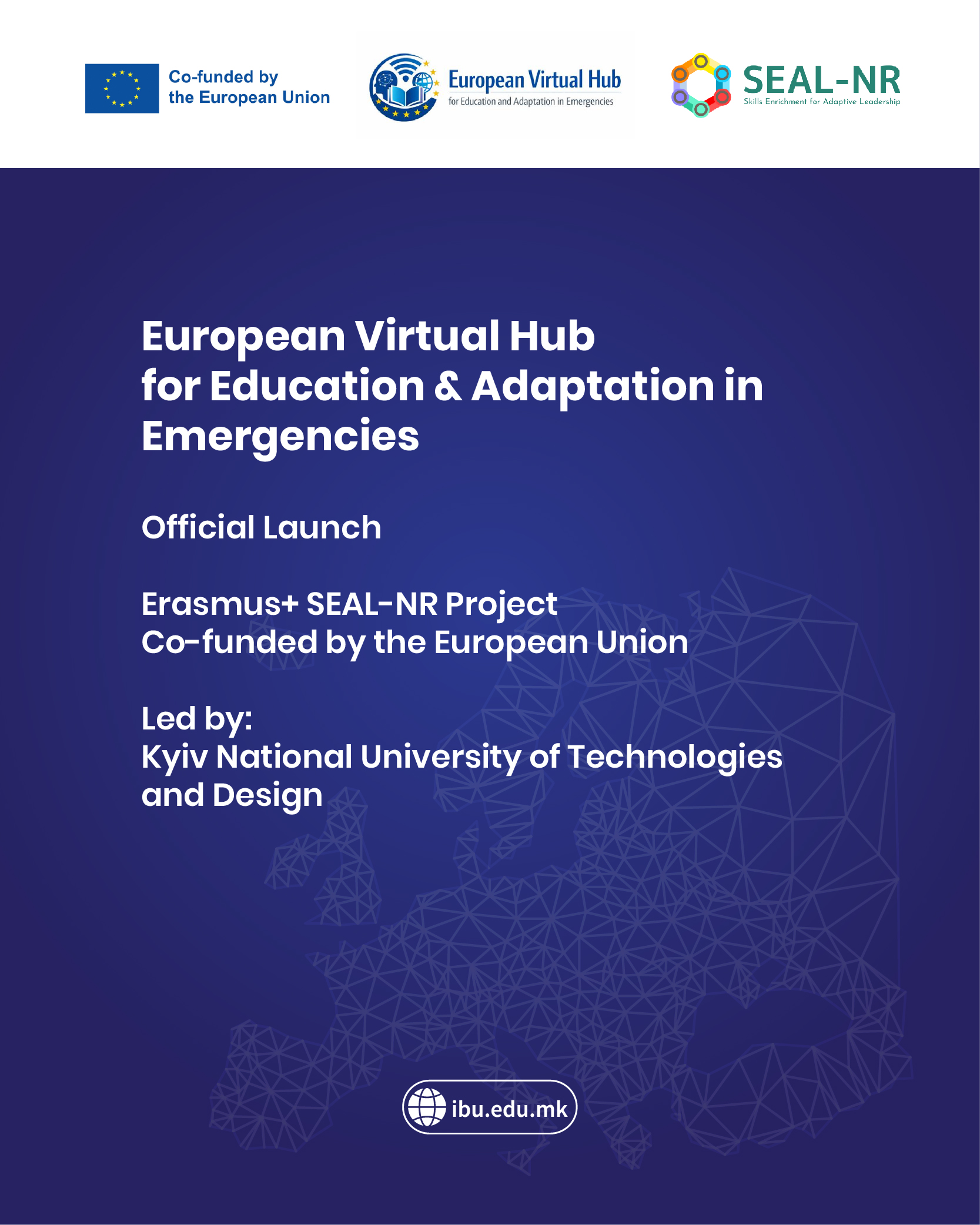
Kyiv National University of Technologies and Design (KNUTD) has officially launched the European Virtual Hub for Education and Adaptation in Emergencies, a new institutional platform established within the framework of the Erasmus+ project Skills Enrichment for Adaptive Leadership in the New Reality (SEAL-NR), co-funded by the European Union.
The Hub has been conceived as a permanent educational and coordination infrastructure designed to support young people, educators, and displaced learners in contexts shaped by crisis, uncertainty, and accelerated digital transformation. Anchored at KNUTD, the Hub integrates both synchronous and asynchronous virtual exchange technologies to ensure continuity of learning, psychological adaptation, and skills development under emergency conditions.
Responding to structural disruptions affecting education systems across Europe and neighboring regions, the European Virtual Hub addresses the consequences of war, forced migration, pandemics, and socio-economic instability. Rather than treating emergencies as temporary deviations, the Hub institutionalises adaptive education as a long-term capacity by combining digital learning, soft skills development, and psychosocial support.
The Hub brings together partner universities and youth organisations from North Macedonia (International Balkan University), Poland (Warsaw University of Technology), Latvia (International Baltic Academy), Ukraine (Kyiv National University of Technologies and Design, the Institute of Social and Economic Initiatives, and the Kyiv Education, Training and Youth Centre), Azerbaijan (Mingachevir State University), and Switzerland (Swiss Center of Excellence Digital Transformation and Ecosystem Leadership – DiTELC).
Functioning as an open digital environment, the Hub hosts certified online courses, interactive training programmes, and learning resources focused on 21st-century skills, social resilience, media literacy, entrepreneurial thinking, and psychological adaptation to emergency contexts.
A distinctive feature of the Hub is its integration of virtual exchanges into both formal and non-formal education. Courses offered through the platform are designed to support recognition through ECTS credits, enabling participants to translate learning outcomes into academic and professional mobility. At the same time, the Hub remains openly accessible, ensuring the inclusion of learners affected by displacement, employment disruption, or barriers to physical mobility.
By institutionalising virtual exchange as an educational infrastructure rather than a temporary solution, the European Virtual Hub positions KNUTD as a regional anchor for adaptive, inclusive, and digitally mediated education. The initiative also contributes to European priorities in digital transformation, inclusion, youth employability, and educational resilience, while strengthening international cooperation among universities in programme and partner countries.
The launch of the European Virtual Hub for Education and Adaptation in Emergencies marks a strategic step toward rethinking education not only as the transmission of knowledge, but as a system of collective resilience, preparedness, and future-oriented skills development in an increasingly complex and changing world.